
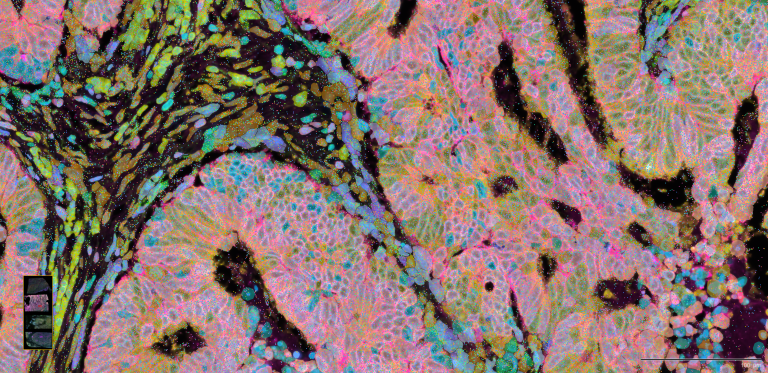
Mundane as it sounds, cutting-edge platforms like the 10x Genomics Xenium® Spatial Analyzer rely on effective, meticulous, and high quality sample preparation to be successful.
As biologists, many of us are familiar with the attention to detail and tedious specifics required to achieve the big-picture, sexy discoveries. Spatial technologies like Xenium Prime 5k are revolutionizing our understanding of how gene expression varies within the complex architecture of tissues. Unfortunately, incomplete fixation, hidden necrosis, or mis-picked tissue regions quietly sabotage expensive runs, leaving you with patchy transcripts and false negatives. Without upstream tissue-quality assessment and array architecture, even the fanciest technology may suffer from a lack of data fidelity.
BioChain closes that gap. Our integrated tissue quality assessment to custom tissue-microarray (TMA) construction pipeline ensures every core you profile actually represents the biology you care about. Let’s talk about it.
Look. It’s just a matter of statistics: the more diverse your array, the trickier it becomes to accurately represent all of it.
Tissue heterogeneity remains a challenge in histopathology and spatial research. Variations in cellular composition, disease progression, and spatial distribution of biomarkers make it difficult to capture the full picture with a single sample. Deviations in tissue sampling can skew results, leading to misinterpretation or even erroneous conclusions. Sub-optimal fixation, necrosis, or off-target punching all translate into patchy transcripts, noisy segmentation, and expensive re-runs. Xenium’s own sample-prep group warns that tissue QC (with H&E) is critical for sample selection, and that poorly processed blocks or mismatched float-times will derail an otherwise perfect run.
For any FFPE section you intend to profile, there are some key things to look out for:
Minimise heat and re-embedding stress. Even short temperature spikes raise gDNA and erode assay sensitivity.
At BioChain, we understand that the accuracy of TMAs is the cornerstone of downstream spatial analysis. That’s why we’ve made it our mission to integrate expert TMA construction services into our in-house Xenium workflow in a way that will ensure your every sample is as representative as possible. Our expertise means we know some of the common pitfalls – like float-time mismatch or over-packing the mold – and have tried and true protocols in place to avoid them. Let’s take a bird’s eye view look at our process:
While any lab can follow Xenium’s public protocol, partnering with an experienced provider can flatten your learning curve and improve your study’s outcomes. We can promise:
Collaborating with our long-time partner 10x Genomics, BioChain constructed TMA for Xenium R&D. The 10x Genomics sample-prep team needed an FFPE block that:
BioChain engineered the array by:
The finished block (pictured below) now serves as the visual benchmark for new Xenium users worldwide—a real-world proof that meticulous sampling plus disciplined construction pays dividends in data quality.
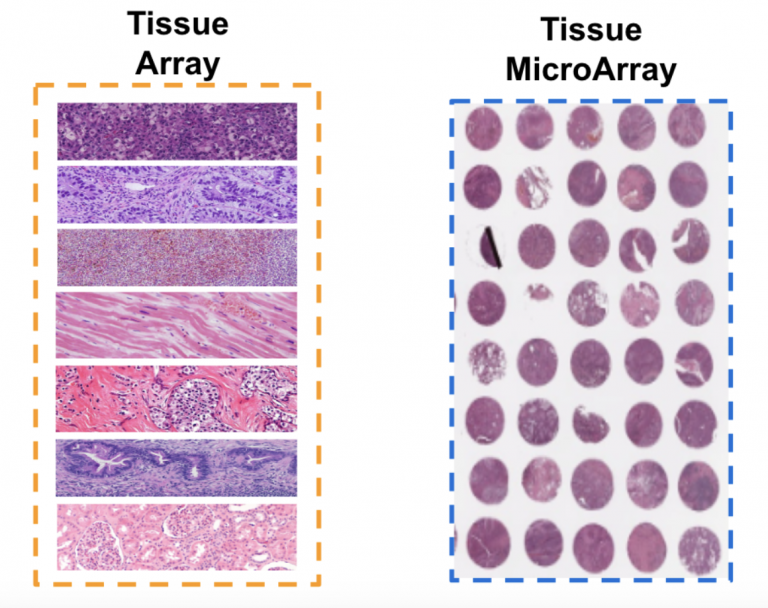
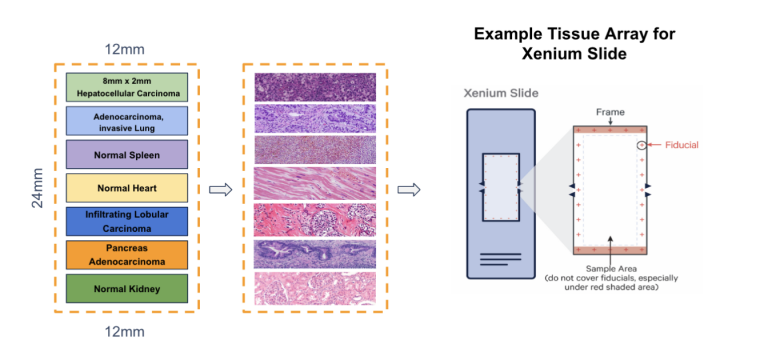
Figure 1 & 2: Sample BioChain Tissue Micro-Array for a single Xenium slide containing seven different tissues that fit in the Xenium sample area. (10x Genomics)
The construction of high-quality tissue arrays is a cornerstone of successful, cost effective spatial transcriptomics experiments. At BioChain, we understand the critical importance of tissue array construction and quality assessment in generating reliable, reproducible, and insightful data. Our expert team, combined with cutting-edge technology and a commitment to precision, ensures that your research is built on the strongest possible foundation.
By partnering with BioChain, researchers can unlock the full potential of spatial transcriptomics and gain deeper insights into the molecular landscape of tissues, helping to advance scientific discovery and drive progress in areas such as disease research, drug development, and personalized medicine.
Ready to rest easy about your next spatial project? Have more questions?
Explore BioChain’s spatial-biology services or reach out with your own sampling challenge—our pathologists love a good puzzle.
Spatial is complicated. We’re here to make it simple.